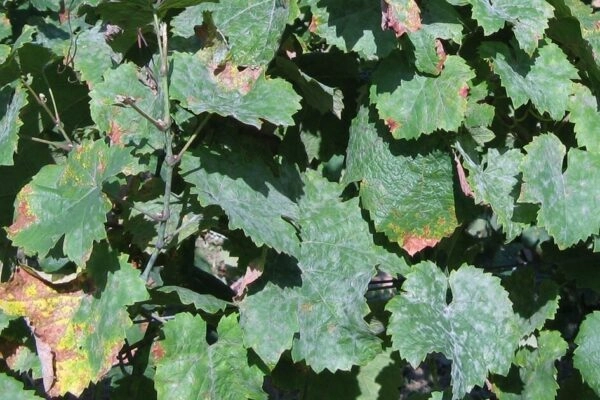
Oidium (powdery mildew of the grapevine) is an important fungal disease in viticulture, which is known in particular for its negative effect on the flavour of the wine. The infestation is visible in the form of a completely floury-grey coating on the young shoots of the vine.
However, the similar name should not lead to confusion. This is because the two fungal diseases differ greatly in terms of their physiology. While the Powdery mildew to the tube fungi (pathogen: Uncinula necator), the Downy mildew the egg fungi (pathogen: Plasmopara viticola). Also the Weather conditions, which lead to increased disease pressure differ between Oidium and Peronospora.
Oidium has been occurring on cultivated vines in Europe since 1845, causing considerable economic damage to the affected vineyards. Worldwide Oidium is the most common disease of grapevines. Especially before the Impairment of the wine flavour The winegrowers are afraid of this. Just 5 - 10 % grapes infested with oidium are enough to spoil the harvest. unusable to make. Extreme damage often occurs to Portugieser, Kerner, Chardonnay and Trollinger, for example.
Overwintering - two options for powdery mildew
The Overwintering of the Oidium fungus occurs in two ways. In Germany, it is assumed that the fungus usually overwinters as mycelium (several fungal threads) on the bud scales. As the fungus does not actually die, in contrast to Peronospora not a primary infection. The first infection of young shoots is possible shortly after budding. Fungal growth begins with the start of bud growth and the hyphae (individual fungal filaments) spread on the plant tissue. The Oidium fungus thus grows directly on the parts of the buds colonised in the previous year. Conidia carriers are formed on the mycelium, which carry spores of the oidium.
In addition, the overwintering of powdery mildew by Formation of a permanent organ (chasmothecium, previously cleistothecium) possible. The Chasmothecia overwinter hanging from the bark of the perennial wood. Warm, dry weather in late summer and autumn favours this form of overwintering. The hook-shaped appendages of the mature chasmothecia attach themselves to the rough areas of the wood. A minimum temperature of >4°C is required for these to lead to infection. In contrast to the first form of development, precipitation >2.5mm is also required. Only then is it possible for the so-called ascospores to emerge from the permanent organ, which then enable the infestation described above.
Oidium damage pattern
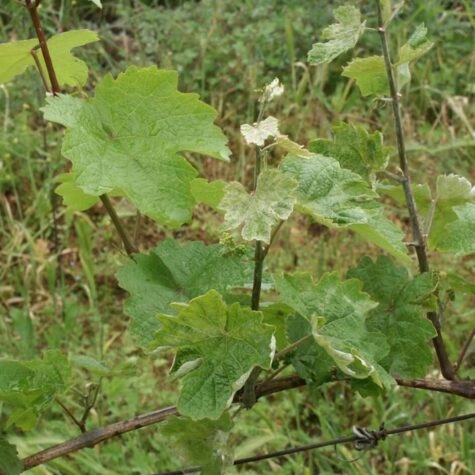
Sporulation of the pathogen begins at the 6-leaf stage. An infestation is only visible afterwards through a sometimes completely floury-grey coating on the young shoots. labelled, the Pointer drives (Fig. 2). But beware: often only individual leaf segments are affected, which manifests itself, for example, in the form of a growth disorder. Similarly, slightly curled leaf edges and a whitish to greyish, wipeable fungal turf on shoots, clusters and shoots can also be a sign of the disease. First sign of oidium be.
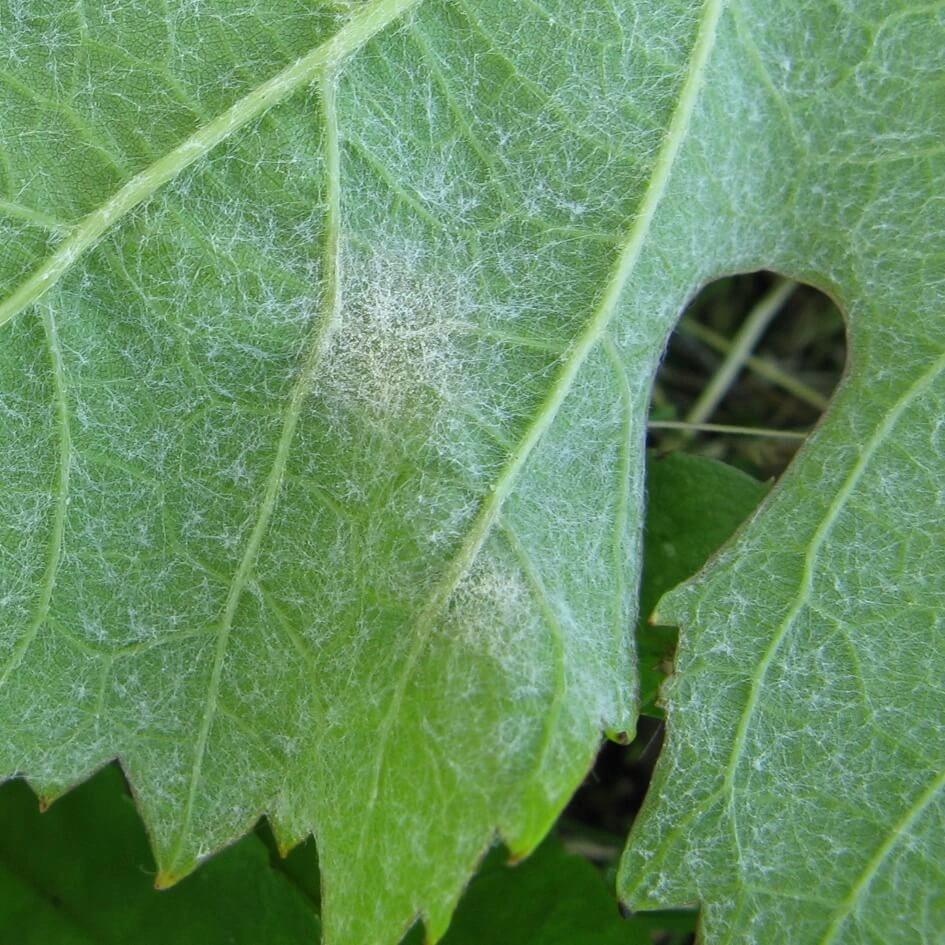
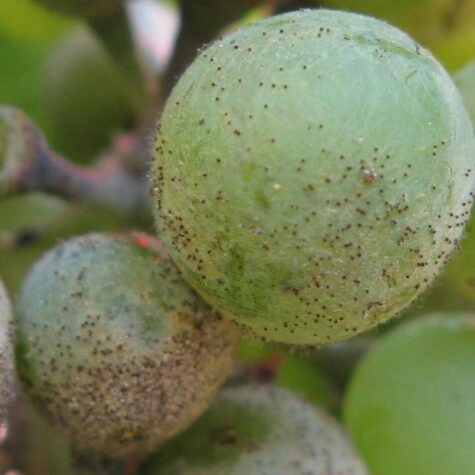
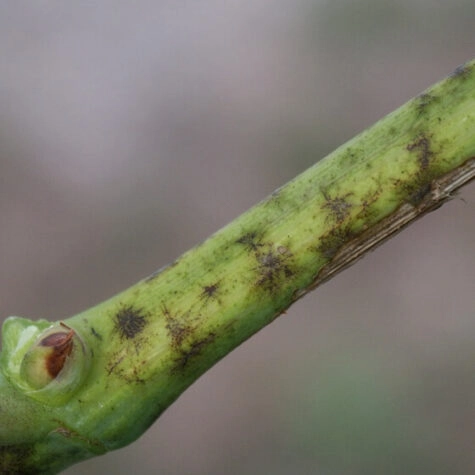
Over the course of the season mealy-grey coating, mostly on the underside of the leaf, at a Infestation with oidium (Fig. 1). This infestation by Oidium is then visible on the upper side of the leaf by a lightening of the leaf tissue. In warm, dry weather in late summer and autumn, the chasmothecia also become visible. These can be identified by yellowish and, with increasing development, black dots in the white fungal turf (Fig. 3). In winter, you can recognise originally infected canes by the red-purple oidium figures on the bark (Fig. 6).
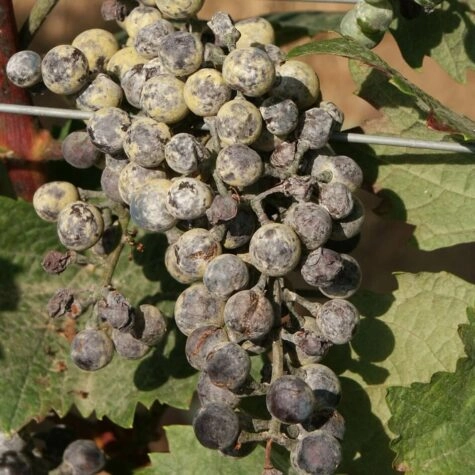
Likewise, a Grape infestation by oidium possible. This prevents the berry skin from growing and, as the fruit flesh and seeds continue to grow, the berries burst open. This results in the so-called seed burst and the seeds become visible (Fig. 5).
Powdery mildew and the weather - Be warned in high-pressure weather conditions!
High-pressure weather conditions are particularly favourable. These are associated with dry and mostly sunny weather during the day. At night, however, temperatures drop and the relative humidity rises. The warm temperatures during the day promote mycelium growth, whereby the Temperature optimum is 26°C. The Optimum relative humidity for Oidium lies between 83 - 86.5 %. While rainfall promotes the release of ascospores (see above), it is a hindrance to the further development of powdery mildew. The superficially growing fungus is washed away by rain.
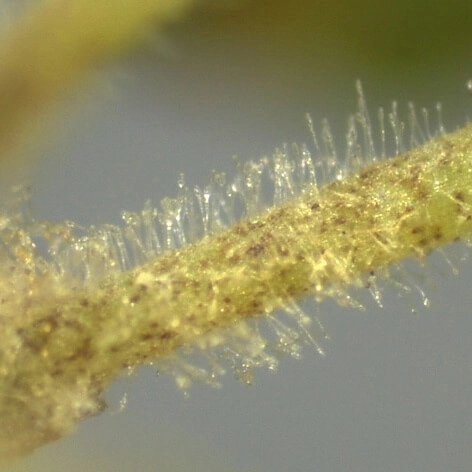
Another decisive variable is the wind. The branches growing vertically upwards on the hyphae carry so-called basal cells, which can form new spores through cell division (Fig. 4). From wind speeds of 2.3 m/s these cells can detach. As conidia sink very slowly, they can be carried by the wind over very long distances.
The oidium window - pay particular attention between BBCH 57 to BBCH 73
The young tissue of the vine, which is still in the process of cell division and elongation, is particularly susceptible. Shortly before flowering (BBCH 57) until the berries are the size of a shot grain (BBCH 73), this is also referred to as the „Oidium window.“ The susceptibility then decreases significantly. From the beginning of sugar storage, the berries also become resistant.
It is therefore particularly important for forecasting models to map the phenological stage realistically. The forecasting system VineForecast uses an interaction component and a learning algorithm to map the phenology specific to the vineyard and grape variety. The disease models for the individual vineyards are therefore adapted to the Oidium window.
Fighting oidium - how a new forecasting system can help you
Once the cells have been damaged, healing is no longer possible or only possible to a limited extent. Preventive (protective) treatment is therefore imperative. A prognosis system can also help to estimate the correct injection time. While the prognosis system VitiMeteo is based on a local weather station, gives VineForecast forecasts tailored to the vineyards of a winery. VineForecast is also working on a farm-specific spraying recommendation (including a suggested agent) to combat powdery and downy mildew.
Forecasting systems give an impression of the current infestation pressure. Nevertheless, sound expertise is essential. For example, an infestation in the previous year is decisive for the following year. A heavy Oidium infestation can be recognised by the Oidium figures (Fig. 6). In this case, early treatment at the 3-leaf stage (BBCH 13) is recommended. After infestation-free years, it is usually sufficient to start treatment together with Peronospora. In the pre-flowering stage, the use of net sulphur is primarily recommended. The lack of resistance development also makes an important contribution to anti-resistance management. It also achieves good additional effects (e.g. against curly mite). Due to the short duration of action of sulphur, it is advisable to use potent organic fungicides during the Oidium window and in warm, dry weather (if possible).
The last treatment should be carried out around the start of ripening (BBCH 81). Even if the berries are then resistant, a late infestation of the leaves can inhibit photosynthesis. In addition, a Infestation in late summer/autumn to the formation of chasmothecia and mycelia and is therefore the Basis for higher infection pressure in spring. In addition, a loose foliage wall, early break-out of pointer shoots and optimum nitrogen fertilisation are crucial.