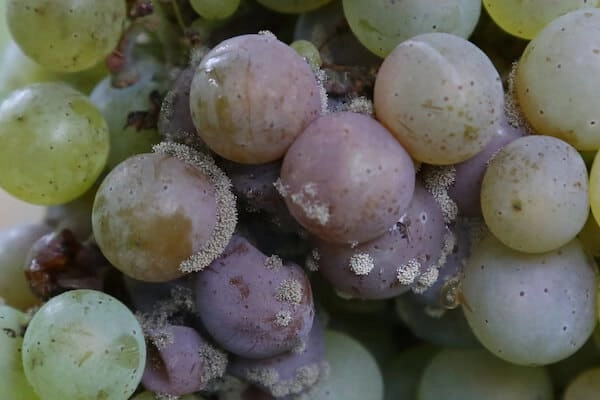
Grey mould (Botrytis cinerea) is a mould fungus or a parasite, which caused considerable damage to the green vine tissue and other cultivated plants such as fruit trees or ornamental plants.
Wine grapes such as Pinot Noir, Chardonnay or Semillon are usually particularly susceptible to botrytis due to their high sugar content. One of the most striking symptoms of Botrytis infestation is a greyish fungal turf. For this reason Botrytis often also called grey mould, grey mould rot or grey rot.
How does botrytis infect the vine?
The life cycle of the Botrytis fungus begins after the Overwintering based on its resistant permanent form (sclerotium). This can be found, for example, in plant remains from the previous year. In addition, under mild climatic conditions, the fungal network (mycelium) can also survive the winter in the bark of the vine. Both the sclerotium and the mycelium produce spores (conidia) during longer periods of wetness from spring onwards. These spores can then infect fresh plant tissue.
The primary infection of grey mould rot can already occur during flowering. The ovaries, the stigma and also the flower caps are particularly susceptible to infection (see Figure 1). A new mycelium can now form within the infected tissue. This can form conidia again later in the year. If infections originate from these conidia formed later in the year, these are also referred to as secondary infections. However, these secondary infections often only occur when the berries start to colour (from BBCH 83), as the still young berries are naturally more resistant to Botrytis.
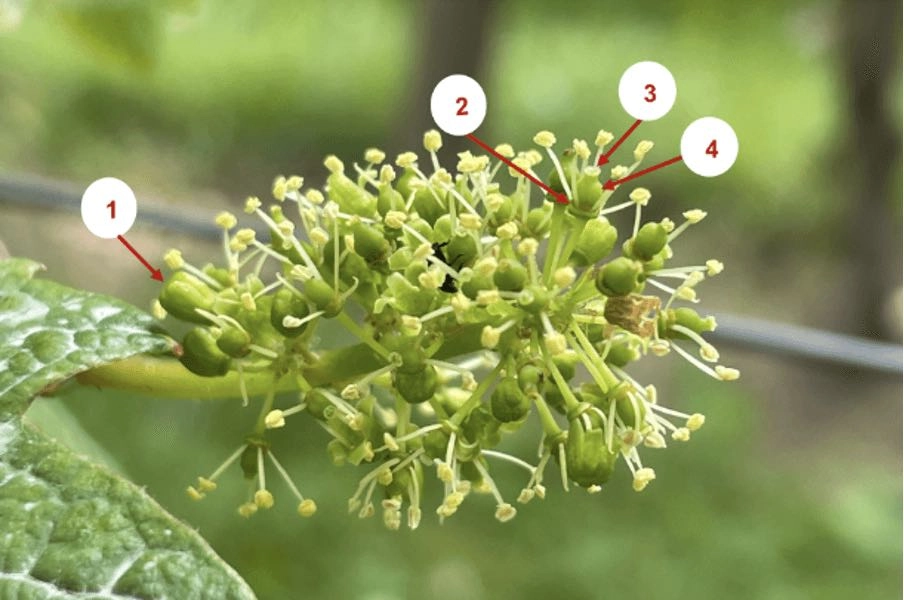
Fig. 1The flower caps (1), the flower base/flower axis (2), the stigma (3) and the ovary are particularly susceptible to infection with Botrytis.
What factors favour infection with grey mould?
A A warm and humid microclimate is particularly favourable for the development of a Botrytis epidemic. While, as mentioned above, long periods of leaf wetness are important for spore germination and infection with Botrytis, mycelium growth within the plant tissue requires only high humidity but no leaf wetness. In addition to these microclimatic factors, factors such as flower residues in the grapes, compactness of the grapes or damage to grapes caused by hail, for example, also play a decisive role in the development of grey mould rot.
Since Botrytis cinerea a weak parasite When the grapevine is very dry, flower remnants that get caught between the berries and damaged grapes are a favourite place for Botrytis infection. If these infections form a mycelium that sporulates later in the year, the nearby grape material can now easily be infected. If the grapes are also compact (no loose cluster structure), the Botrytis-infected berries do not simply fall to the ground, but remain in the cluster. This further increases the infection pressure on the still healthy berries in the bunch.
The compactness of the grapes is promoted, among other things, by high rainfall after flowering, as this allows more water to reach the grapes. In contrast, precipitation during flowering (trickling of the flower), but also low temperatures during this period (<15° C), promote a loose grape structure. Researchers even suspect that a Trickling of the blossom the infestation with Botrytis at the end of the season although the humid weather conditions during the rainy periods initially increase the risk of infection (https://oeno-one.eu/article/view/36). The loose cluster structure created by the trickling reduces the risk of infection for the rest of the season and thus overcompensates for the influence of rainfall on the infection process during flowering.
Botrytis damage pattern - grey mould rot, sour rot, noble rot & Co.
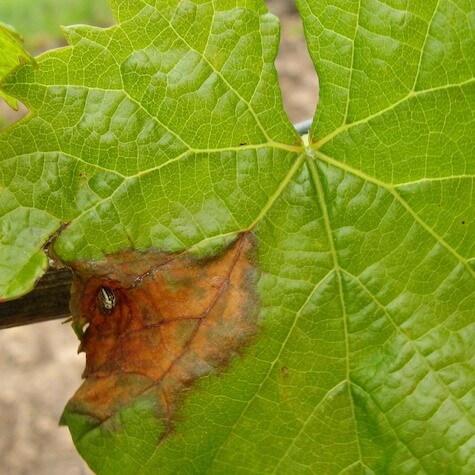
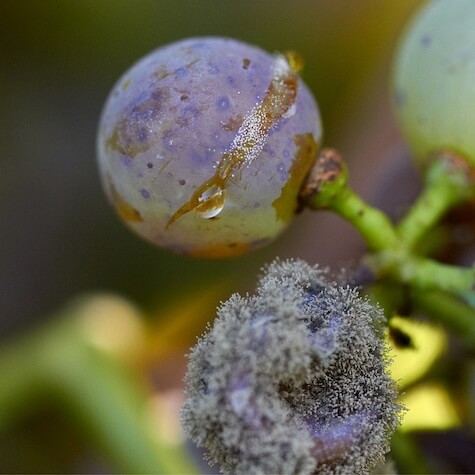
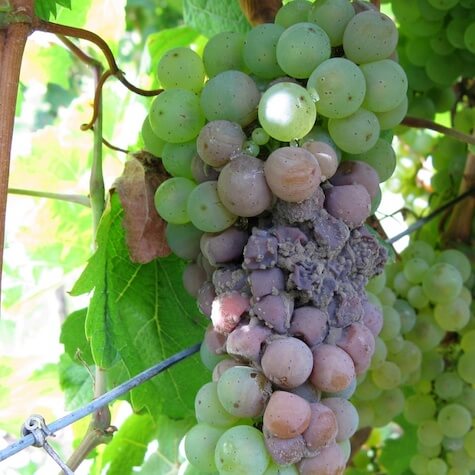
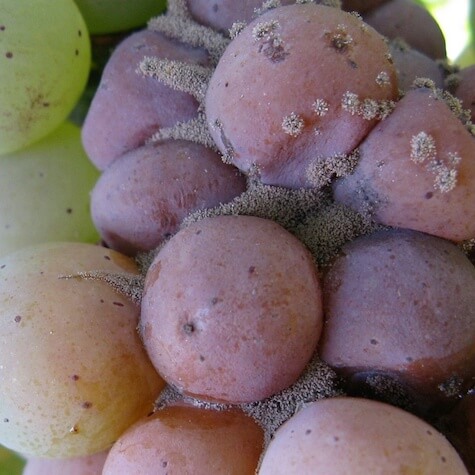
Even buds and young shoots can be infested with botrytis. Brownish discolouration, dried plant tissue and a greyish fungal turf indicate an infestation. On young leaves, the infestation is mainly characterised by necrotic spots. If shoots are infected, brown, sometimes even black spots appear on the surface of the flower stems and flower caps. As soon as the grapes have begun to ripen, the botrytis fungus has an easy time of it and can infect the entire bunch of grapes. The distinctive greyish cotton wool coating of the mycelium and the conidia of the grey mould rot then becomes visible (see Fig. 6).
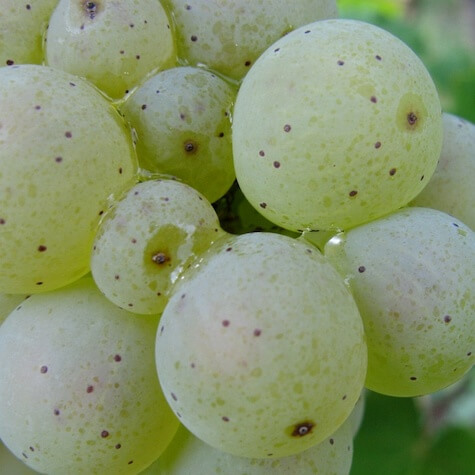
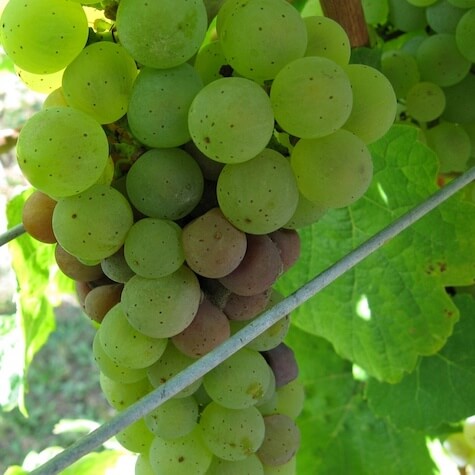
Botrytis infection in grapes often develops from the inside out. Blossom remnants that remain inside the grape favour the development of such a centre of infection (see above). This can also lead to infection of the grape stalks (stalk rot). The Stem rot leads to an undersupply of the berries, which becomes visible through purple and later brown grapes (see Fig. 2 - 4). With severe stem rot, grapes can even detach from the vine and fall to the ground.
If berries are infested with botrytis before ripening, this is also referred to as the so-called Acid rot. Sour rot is often accompanied by other infections caused by other fungi and bacteria, which can cause additional damage to the grapes. Once the grapes are fully ripe, on the other hand, the Noble rot This is because Botrytis infestation may even be desirable at this stage (sweet white wines).
Source: HS Geisenheim
Conventional plant protection measures against Botrytis
In conventional viticulture, synthetic fungicides are often used to combat botrytis. Active ingredients such as fenhexamid, fludioxonil or pyrimethanil are important fungicides against Botrytis infestation. Important dates for the These botryticides are used at the end of flowering (BBCH 68), the beginning of grape closure (BBCH 77) and the beginning of ripening (BBCH 81). Caution: In the interests of good resistance management, care must be taken to ensure that fungicides of different resistance classes with different modes of action are used in successive plant protection measures.
Ecological measures against grey mould
In addition to these conventional methods for containing grey mould rot, there are numerous biological and Cultivation measures for the development of grey mould to prevent the formation of mould. Potassium hydrogen carbonate (baking powder), for example, shows a Good effect against botrytis in the event that the disease pressure is not too high. Recently, a Positive effect of calcium propionate in the control of Botrytis. However, there is currently no plant protection product with calcium propionate as an active ingredient that has been authorised for use in viticulture.
In the area of cultivation technology, measures that avoid high humidity and promote aeration, such as the Defoliate the grape zone to prevent botrytis infestation. In addition, the infection pressure during ripening can be reduced at an early stage by removing flower remnants (blowing out after flowering). Furthermore, the risk of infection is reduced if a loose bunch structure is promoted by measures such as dividing the bunches. Direct sunlight on shoots, blossoms and young berries (BBCH 53 - BBCH 73) can in turn increase the risk of infection. Resistance to botrytis during this growing season increase.
How can a botrytis forecast support winemakers in their decision-making?
The type of prognosis of Botrytis differs significantly from the prognosis of Peronospora and Oidium. Peronospora and Oidium forecasts help wineries to estimate the infection pressure and risk of infestation of the respective disease in the coming days. If infections are predicted, a (new) plant protection measure may be necessary in the run-up to these infection days.
In contrast, the botrytis forecast is concerned with estimating whether past and future weather periods (periods of several days and weeks) will lead to an early start of a botrytis epidemic. Favour botrytis epidemic at the end of the season. If the signs are good for an early start to the epidemic, then the measures that favour a delayed start to the epidemic (see above) should be taken into consideration.
Forecast models can be obtained from government institutions (e.g. VitiMeteo). For a more detailed assessment VineForecast forecasts for the entire operating area without the need to purchase weather stations.