Leaf wetness - the central variable for the prognosis of a fungal disease
Our last guest article by plant biologist Janna Einöder was about downy mildew and how it can attack and damage vines. The central variable for a Infection of the vines The most important factor in the fungal disease is the duration of leaf wetness, because summer spores can only develop if vine leaves are wet with water for a sufficiently long time.
It is therefore important to recognise the conditions for spore formation at an early stage. Firstly, this requires a reliable prediction of leaf wetness. Leaf wetness sensors can only indicate the current state and cannot make any statements about future leaf wetness. For effective vine protection, however, spray agents usually have to be on the plant before an infection event. For this reason, an accurate prediction of leaf wetness is essential for effective vine protection against downy mildew.
The microclimate of a vineyard is decisive for leaf wetness
Hardly any other meteorological variable is more influenced by the microclimate of a vineyard than leaf wetness. Even over a short distance of a few hundred metres, the duration of leaf wetness can vary greatly. Topography in particular plays a decisive role here. This is also the experience of many winegrowers.
Philipp Franzen from the Steep property on the Moselle recently told us about this. In his east-facing vineyards, he observes a lower susceptibility to downy mildew than on west-facing slopes. Vine leaves that are wet in the morning due to dew or overnight precipitation dry most quickly on east-facing slopes that are exposed to the morning sun. In contrast, the sun reaches the shady western slopes much later and they therefore remain wet for longer. The risk of infection by Peronospora is significantly higher in these locations.
The leaf wetness forecast from VineForecast
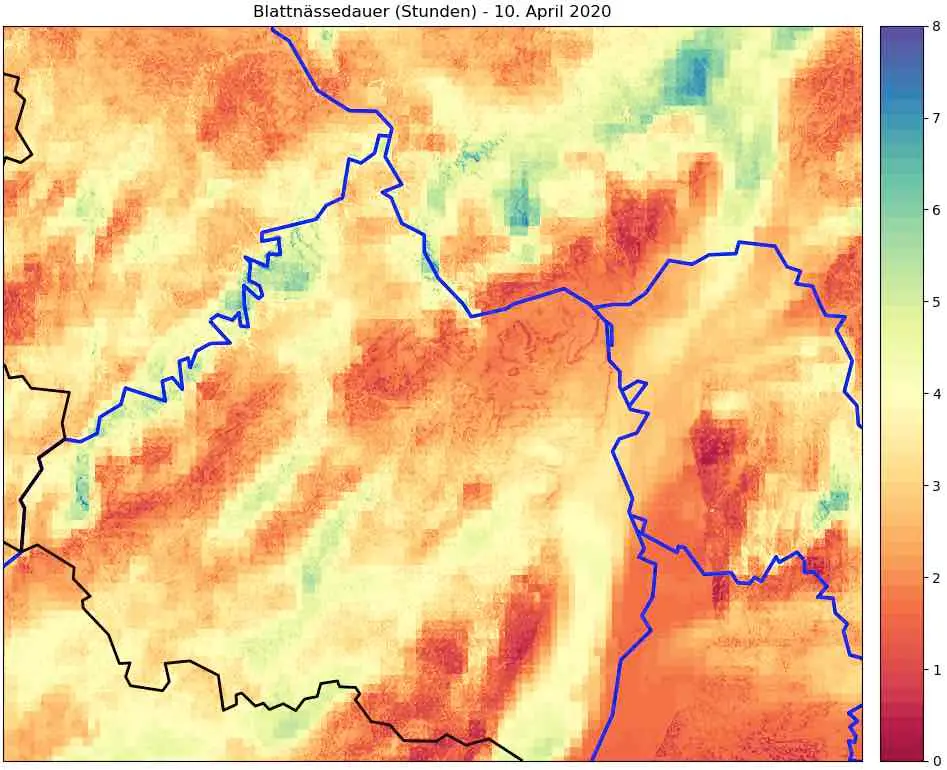
In order to be able to provide a reliable leaf wetness forecast and thus also enable an accurate disease forecast, we invest in VineForecast We have invested a lot of time in the (further) development of our leaf wetness model. By integrating the topography into our models, we have been able to make detailed statements about leaf wetness.
The map above shows our leaf wetness forecast for the Moselle, Rheinhessen, Nahe, Rheingau, Middle Rhine and Palatinate wine-growing regions. You can clearly see how the forecast is strongly influenced by the different topographical conditions.